The Complete IT Infrastructure Checklist for SMEs in India
Imagine investing ₹50 lakhs to build a modern office, purchasing high-end computers for every employee, installing CCTV cameras, biometric systems, ERP software, and hiring a talented workforce.
Now imagine connecting all of it using a basic consumer Wi-Fi router purchased online because it was “cheap.”
It may sound unrealistic, but this happens far more often than most business owners realize.
Across India, thousands of Small and Medium Enterprises (SMEs), educational institutions, manufacturing industries, warehouses, hospitals, and corporate offices continue to underestimate the importance of professional IT infrastructure planning. Many organizations spend months selecting furniture, interiors, machinery, or production equipment, yet make technology decisions in just a few hours based solely on the lowest quotation.
The result?
Slow networks.
Frequent internet issues.
Unexpected downtime.
Data loss.
Security vulnerabilities.
Frustrated employees.
And eventually, much higher expenses than if the infrastructure had been planned correctly from the beginning.
Why Most Businesses Delay IT Infrastructure Investments
One of the biggest misconceptions among growing businesses is that IT infrastructure is a non-essential expense.
Unlike production machinery, office expansion, or marketing campaigns, technology infrastructure often doesn’t appear to generate immediate revenue. Because of this, many organizations see it as a “dead investment”—something that can be postponed until the business grows larger.
This mindset is understandable.
Every business has budgets, and every investment must be justified. Business owners naturally prioritize projects that produce visible returns.
However, the reality is quite different.
A properly designed IT infrastructure doesn’t simply support your business—it enables it.
Every email sent, every invoice generated, every ERP transaction processed, every CCTV recording stored, every online meeting conducted, every production report accessed, and every customer interaction depends on a reliable IT environment.
When that infrastructure fails, productivity stops.
The cost of one day of downtime often exceeds the amount saved by choosing the cheapest networking equipment or delaying an infrastructure upgrade.
Instead of asking:
“How much will good IT infrastructure cost?”
Businesses should ask:
“How much will poor IT infrastructure cost over the next five years?”
That single shift in perspective changes everything.
The Hidden Cost of Choosing the Lowest Price
Another common mistake is selecting technology purely based on price.
We’ve seen businesses compare enterprise networking equipment the same way they compare office chairs—choosing whichever quotation is cheaper.
Unfortunately, IT infrastructure doesn’t work that way.
Professional IT infrastructure isn’t just about purchasing hardware.
It’s about designing an ecosystem where every component works together reliably, securely, and efficiently.
A low-cost router may function perfectly in a home.
But can it reliably support:
120 employees?
Multiple departments?
ERP software?
IP phones?
CCTV systems?
Cloud backups?
Guest Wi-Fi?
Video conferencing?
Remote employees?
Future expansion?
Probably not.
The same applies to switches, firewalls, wireless access points, structured cabling, storage systems, servers, and cybersecurity solutions.
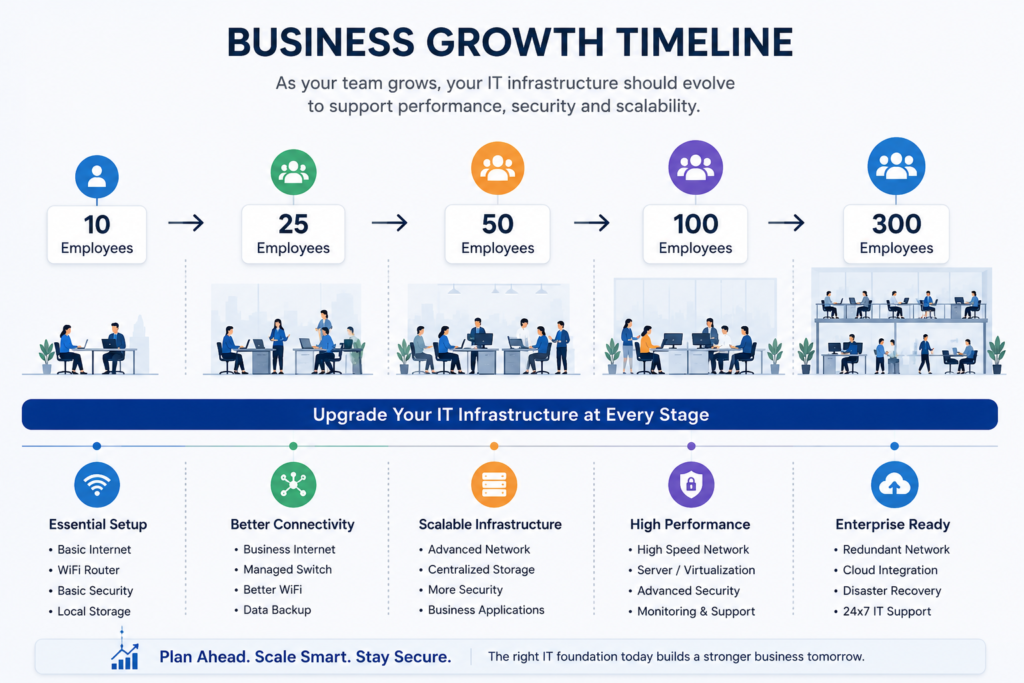
Choosing equipment without understanding your current requirements—and more importantly, your future growth—often results in replacing everything within a few years.
The initial savings quickly disappear.
Every business is different.
Let's plan the right IT infrastructure for yours. →
Why Professional IT Planning Matters
One of the biggest differences between a growing business and a professionally managed organization is planning.
When constructing a building, businesses consult architects.
When installing electrical systems, they hire qualified electricians.
When designing a factory, they work with engineers.
Yet many organizations still purchase networking equipment, servers, storage devices, CCTV systems, and Wi-Fi solutions without consulting experienced IT professionals.
Technology has become too important to be treated as an afterthought.
Every business has unique requirements.
A manufacturing plant has different networking needs than a school.
A hospital requires stronger data security than a retail store.
A logistics company depends on uninterrupted connectivity across warehouses.
A corporate office needs secure collaboration, remote access, and cloud integration.
There is no universal IT infrastructure that fits every business.
Professional planning ensures your investment aligns with your operations today while remaining ready for future growth.
What Exactly Is IT Infrastructure?
Many people think IT infrastructure simply means computers and internet connectivity.
In reality, it is much broader.
IT infrastructure is the complete technology foundation that keeps an organization operating every day.
It includes every system responsible for communication, collaboration, security, storage, networking, computing, and business continuity.
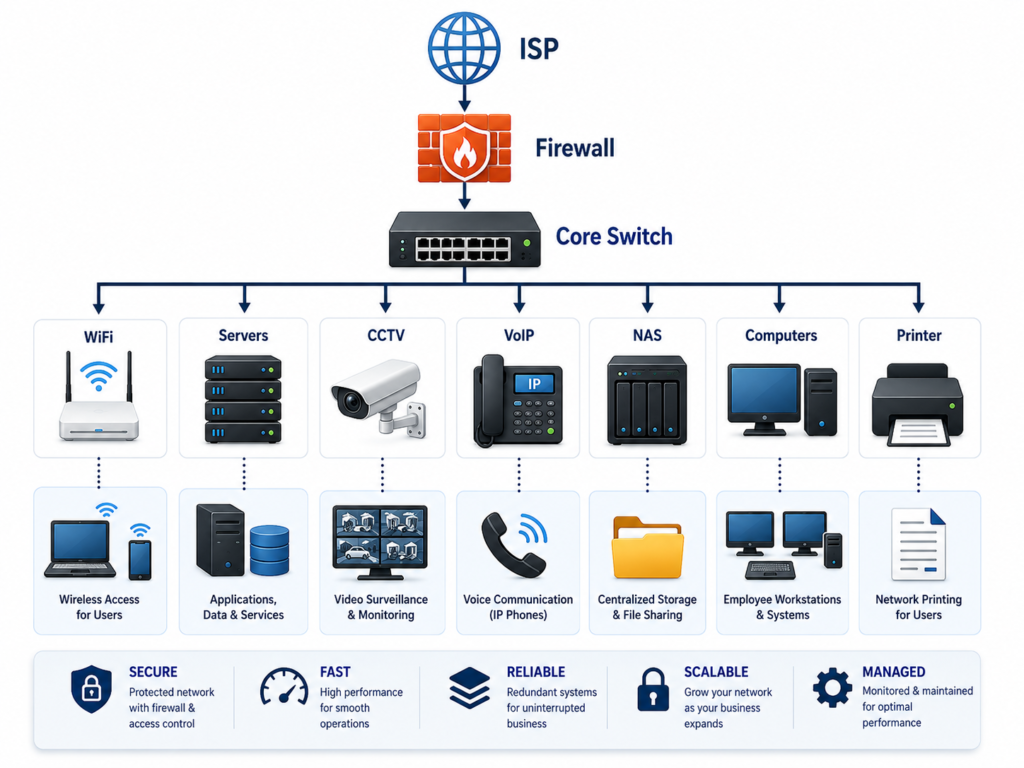
A modern business IT infrastructure typically includes:
Network Infrastructure
The backbone connecting every employee, department, and office location.
This includes:
Enterprise routers
Managed switches
Structured cabling
Fiber connectivity
Enterprise Wi-Fi
Network racks
VLAN configuration
Servers & Storage
Business applications and data need secure and centralized storage.
This may include:
File servers
Application servers
Virtual servers
NAS storage
Backup storage
Cloud storage
Active Directory
Cybersecurity
Protecting business data is no longer optional.
Modern cybersecurity includes:
Business firewalls
Endpoint protection
Email security
Multi-factor authentication (MFA)
VPN access
Security monitoring
Patch management
Business Productivity
Employees depend on reliable technology every day.
This includes:
Microsoft 365
Google Workspace
ERP systems
CRM software
Video conferencing
Collaboration tools
Business email
Backup & Disaster Recovery
Hardware failures, ransomware, accidental deletion, or natural disasters can occur at any time.
Every business should have:
Automated backups
Cloud backups
Local backups
Disaster recovery plans
Recovery testing
Without a tested backup strategy, even a small incident can result in significant financial loss.
Physical IT Infrastructure
Technology extends beyond computers.
Physical infrastructure includes:
CCTV surveillance
Access control systems
Biometric attendance
Server racks
UPS systems
Power backup
Environmental monitoring
Together, these components create a secure and reliable business environment.
IT Infrastructure Is an Investment, Not an Expense
Perhaps the most important lesson businesses can learn is this:
Good IT infrastructure rarely receives appreciation because everything works.
Poor IT infrastructure receives attention every single day.
Employees complain about slow internet.
Meetings disconnect.
Files disappear.
Applications become sluggish.
Servers fail unexpectedly.
Cybersecurity incidents occur.
Business operations slow down.
Customers notice.
The best IT infrastructure is often invisible—it quietly supports every department, every employee, and every customer interaction without interruption.
Rather than asking how little can be spent on technology, forward-thinking organizations ask how technology can help them become more efficient, secure, and scalable.
That is the difference between using IT as a cost centre and leveraging it as a business growth enabler.
In the next section, we’ll walk through the complete 2026 IT Infrastructure Checklist, covering every essential component—from networking and cybersecurity to cloud services, IT asset management, backup strategies, and maintenance—so you can evaluate whether your organization is truly prepared for the future.
Discover the hidden IT costs silently affecting your business. Learn how SMEs can reduce downtime, improve productivity, strengthen cybersecurity, and lower long-term IT expenses with smarter infrastructure planning.
Learn how to build a secure, scalable, and high-performance office network. Discover the best practices for business WiFi, firewalls, switches, structured cabling, servers, cybersecurity, and office IT infrastructure.
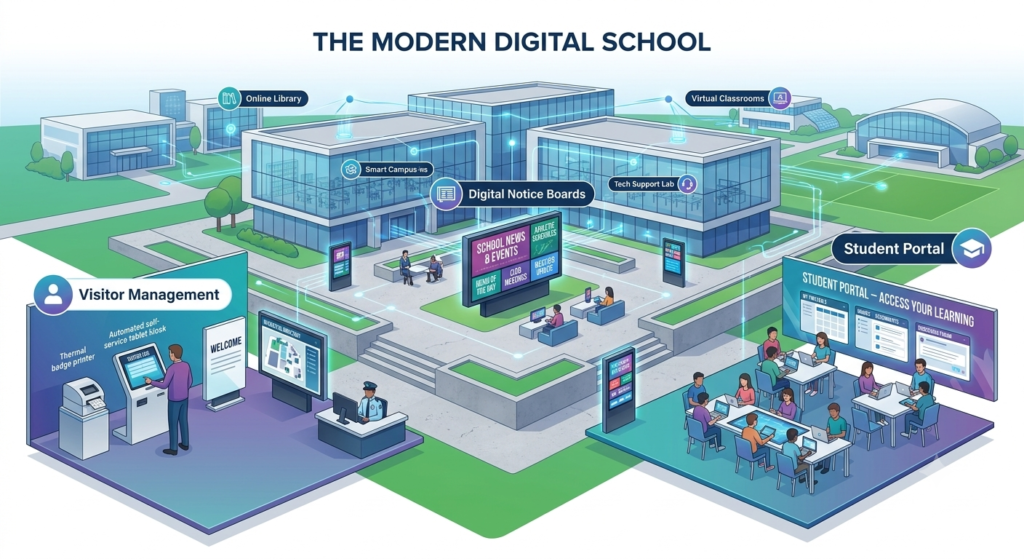
Discover the best IT solutions for schools and colleges, including smart classrooms, campus Wi-Fi, CCTV surveillance, school bus GPS tracking, student portals, digital notice boards, and complete smart campus infrastructure.



 Many people think IT infrastructure simply means computers and internet connectivity.